![SEAO2-CDR [logo]](/themes/seao2-NOC8X/logo.svg)
The ocean is poised to play an essential role contributing to global CDR efforts, but careful stewardship, close collaboration and further research are required to ensure that, where appropriate, mCDR techniques can be deployed in an environmentally safe, socially acceptable and economically viable manner.
SEAO2-CDR is enabling these advancements in knowledge and understanding by integrating scientific, social, legal and commercial knowledge to develop the tools, mechanisms and guidelines required to facilitate the effective and transparent evaluation of mCDR techniques.
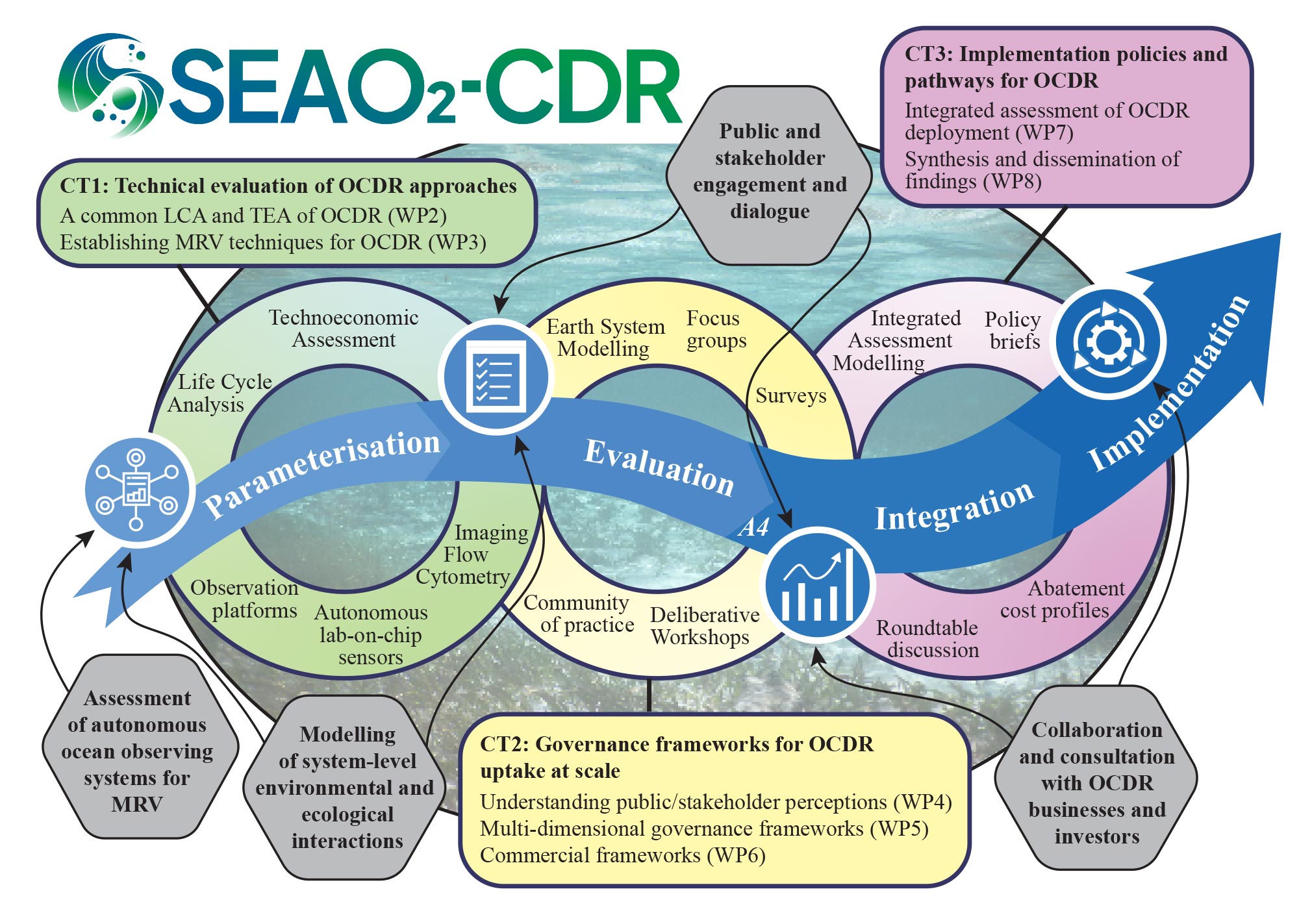
Multidisciplinary assessment and evaluation frameworks and advancements designed to help guide and inform the implementation potential of mCDR are being developed through three core themes within the project:
CT1. Characterising the key system boundaries, processes, material and energy flows of different mCDR approaches and evaluating their temporal and spatial monitoring requirements and mechanisms.
CT2. Establishing the social, regulatory, political, economic and ethical frameworks required to support mCDR uptake at scale.
CT3. Enhancing our understanding of realistic implementation policies and pathways via an integrated assessment of system-level effects.
By delivering the core themes in parallel, SEAO2-CDR is supporting the two-way flow of information between the mCDR sector (commercial entities, investors and regulators), scientific bodies, and other stakeholders (policy makers, environmental NGOs and public bodies), enabling simultaneous and mutually compatible advances in understanding of mCDR techniques. The project is explicitly not seeking to promote, or advance, any single mCDR type or methodology, and our research funding is not being used to facilitate the implementation or upscaling of mCDR technologies. The project does, however, aim to increase trust and confidence in mCDR monitoring and governance capabilities, and to increase support and guidance for mCDR businesses and investors.