![SEAO2-CDR [logo]](/themes/seao2-NOC8X/logo.svg)
SEAO2-CDR is not conducting or directly enabling mCDR field trials or pilot studies. We are, however, advancing our ability to transparently monitor and evaluate those activities and improving our understanding of what information, processes and guidance is required by the public, regulators and decision makers to enable such trials and, where appropriate, commercial mCDR activities to be conducted.
The outcomes of completed case studies can be found in Results and in the publications linked to specific activities below. Alternatively please contact us for further information or to discuss the potential for collaboration through the project.
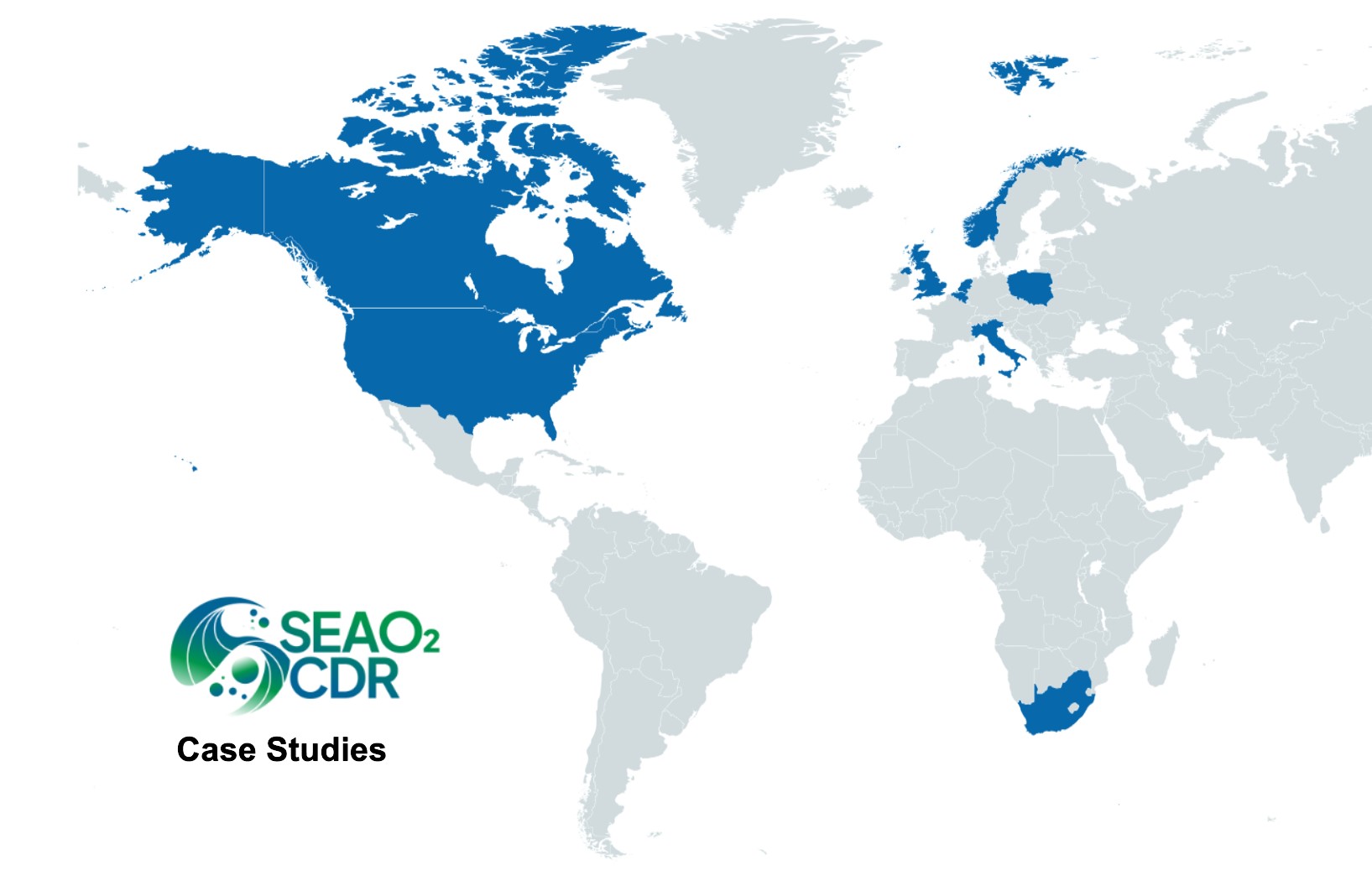
The current case studies and evaluations being conducted through SEAO2-CDR include:
Stakeholder Perception Assessment (WP4)
Aim: To study perceptions associated with different ways of presenting and communicating mCDR among expert stakeholders. The study will explore both visual and deliberative framing implications, particularly in terms of emotional vs. technical and simplistic vs. complex framings.
Outcome Expert stakeholder understandings and perceptions of marine CDR, implications of different visual and deliberative communication frames and potential implications for engaging key stakeholders in mCDR research and deployment.
Lead institute: University of Cambridge
mCDR Deliberative Workshop (WP4)
Aim: To simulate and evaluate real-world negotiation processes in developing guidelines for mCDR deployment.
Outcome : Participants perform and discuss the negotiated rulemaking process, reflecting on its strengths and limitations in the context of mCDR.
Lead institute: CASE
mCDR Deliberative Workshop (WP4)
Aim: To simulate and evaluate real-world negotiation processes in developing guidelines for mCDR deployment.
Outcome: Participants perform and discuss the negotiated rulemaking process, reflecting on its strengths and limitations in the context of mCDR.
Lead institute: CASE
Public Perception Assessment (WP4)
Aim: To examine public perceptions of marine CDR methods (with a focus on ocean alkalinity enhancement and seaweed cultivation), with particular emphasis on evaluating key trade-offs, such as balancing economic, ecological, and social considerations.
Outcome:: Improved understanding of public perceptions of mCDR research and deployment and its potential role in supporting a climate policy portfolio
Lead institute: IfW Kiel
mCDR Deliberative Workshop (WP4)
Aim: To simulate and evaluate real-world negotiation processes in developing guidelines for mCDR deployment.
Outcome:Participants perform and discuss the negotiated rulemaking process, reflecting on its strengths and limitations in the context of mCDR.
Lead institute: CASE
mCDR Deployment Logistics (WP7)
Aim: To evaluate the logistic requirements for at-scale mCDR deployment, with a particular focus on ocean alkalinity enhancement (OAE)
Outcome:Development of an optimised logistic systems model for mCDR deployment including consideration of OAE supply chain networks and CDR optimisation
Lead institute: CAU Kiel
Publication: https://doi.org/10.1016/j.ijggc.2025.104395
Evaluation of Sensor Technologies for mCDR Monitoring (WP3)
Aim:To evaluate the potential for state-of-the-art autonomous marine sensors to be used to support mCDR monitoring, reporting and verification (MRV) requirements.
Outcome: Working in partnership with SeaO2 to improve our understanding of current MRV capabilities and their potential to meet market and regulatory requirements within a real-world scenario.
Lead institute: National Oceanography Centre, in partnership with SeaO2
Public Perception Assessment (WP4)
Aim:To examine public perceptions of marine CDR methods (with a focus on ocean alkalinity enhancement and seaweed cultivation), with particular emphasis on evaluating key trade-offs, such as balancing economic, ecological, and social considerations.
Outcome:Improved understanding of public perceptions of mCDR research and deployment and its potential role in supporting a climate policy portfolio
Lead institute: IfW Kiel
Stakeholder Perception Assessment (WP4)
Aim: To study perceptions associated with different ways of presenting and communicating mCDR among expert stakeholders. The study will explore both visual and deliberative framing implications, particularly in terms of emotional vs. technical and simplistic vs. complex framings.
Outcome: Expert stakeholder understandings and perceptions of marine CDR, implications of different visual and deliberative communication frames and potential implications for engaging key stakeholders in mCDR research and deployment.
Lead institute: University of Cambridge
Public Perception Assessment (WP4)
Aim: To examine public perceptions of marine CDR methods (with a focus on ocean alkalinity enhancement and seaweed cultivation), with particular emphasis on evaluating key trade-offs, such as balancing economic, ecological, and social considerations.
Outcome: Improved understanding of public perceptions of mCDR research and deployment and its potential role in supporting a climate policy portfolio.
Lead institute: IfW Kiel
South Africa: Techno-Economic Assessment of Ocean Iron Fertilisation (WP2)
Aim:To develop a comprehensive framework for conducting a techno-economic assessment (TEA) of mCDR approaches, to investigate the extent to which elements influence the cost of deployment and hence support informed decision making on the potential for deployment
Outcome:Development and application of the TEA framework to the scenario of ocean iron fertilisation (OIF) in the Southern Ocean.
Lead institute: Heriot Watt University
Publication: https://doi.org/10.3389/fclim.2025.1509367
Canada: Evaluation of Sensor Technologies for mCDR Monitoring (WP3)
Aim:To evaluate the potential for state-of-the-art autonomous marine sensors to be used to support mCDR monitoring, reporting and verification (MRV) requirements.
Outcome:Working in partnership with Dalhousie University and Planetary Technologies to improve our understanding of current MRV capabilities and their potential to meet market and regulatory requirements within a real-world scenario.
Lead institute: National Oceanography Centre , in partnership with Dalhousie University and Planetary Technologies
USA: Evaluation of Sensor Technologies for mCDR Monitoring (WP3)
Aim:To evaluate the potential for state-of-the-art autonomous marine sensors to be used to support mCDR monitoring, reporting and verification (MRV) requirements.
Outcome:Working in partnership with Vesta and Hourglass to improve our understanding of current MRV capabilities and their potential to meet market and regulatory requirements within a real-world scenario.
Lead institute: National Oceanography Centre, in partnership with Vesta and Hourglass
Evaluation of mCDR Accounting Methodologies (WP3)
Aim:Model-based assessment of different approaches for quantifying the efficiency of mCDR techniques. Initial focus will be on comparing the effects of ocean alkalinity enhancement (OAE) on seasonality in the ocean carbonate system, comparing behaviour in the North Sea/North Atlantic and the South China Sea.
Outcome:Evaluation of different metrics and mechanisms for evaluating the net efficiency of mCDR approaches
Lead institute: GEOMAR
Creation and support of a mCDR Coalition (WP6)
Aim:To improve collective understanding of mCDR implementation requirements and barriers by proactively engaging and bringing together leading mCDR companies.
Outcome:Creation of a mCDR Coalition that provides a platform for knowledge sharing and collaboration across a variety of mCDR pathways and perspectives.
Lead institute: World Ocean Council, in partnership with the Carbon Business Council and mCDR Coalition