![SEAO2-CDR [logo]](/themes/seao2-NOC8X/logo.svg)
Prof. Phil Renforth, Heriot-Watt University, co-lead SEAO2‑CDR WP2 recaps the recent Ocean Sciences Meeting in Glasgow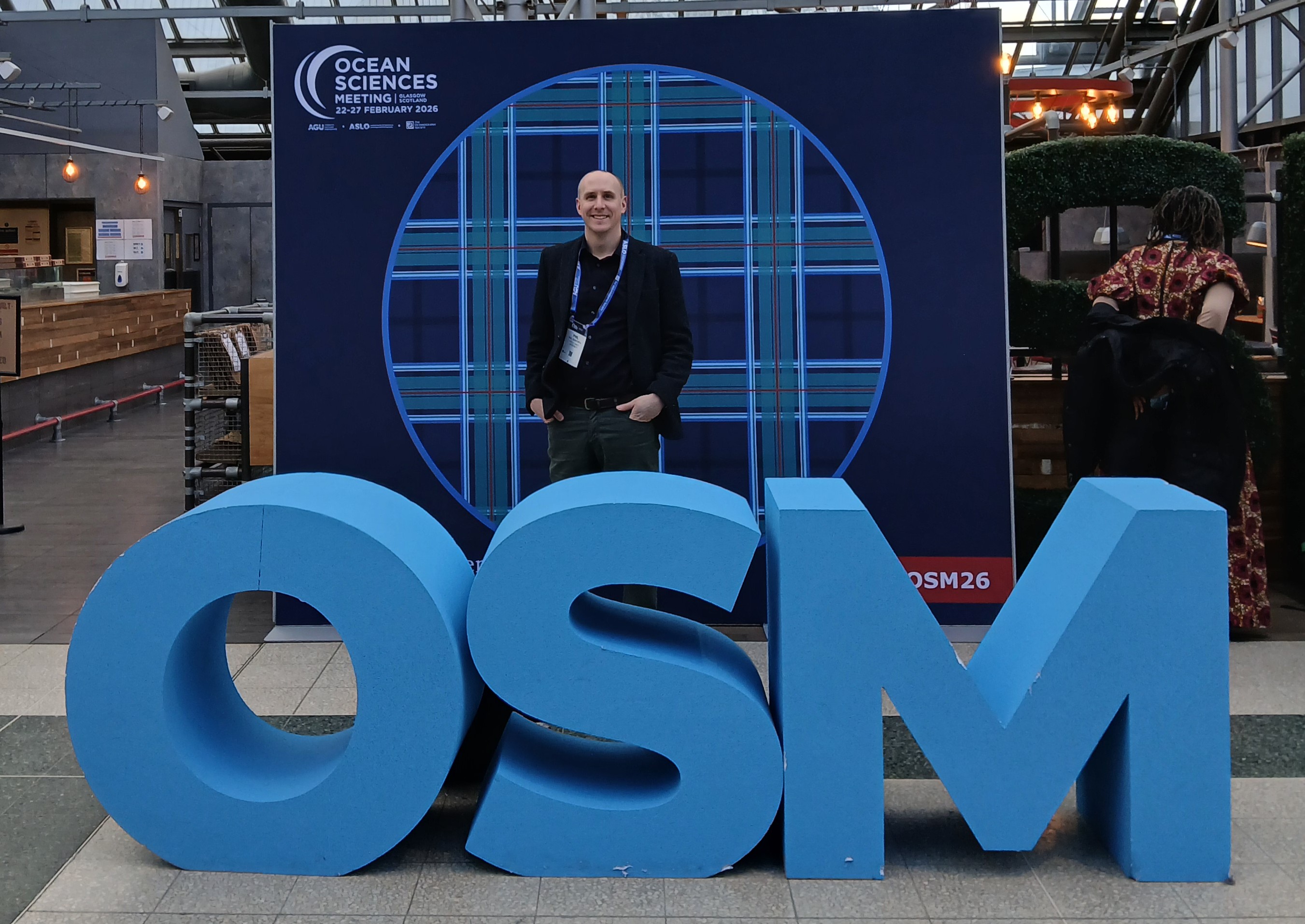
The format of the 2026 Ocean Science Meeting was a first for many of us. You would have thought that running half a dozen sessions concurrently in a single room involving hundreds of attendees would be recipe for carnage. Yet, the space was disconcertingly quiet. Only after donning a set of headphones inspired by the 1982 movie Tron, were we transported to a one-sided conversation with the presenter.
Chairing a session on Interdisciplinary Approaches and Scalable Pathways for Marine Carbon Dioxide Removal (mCDR) at the Ocean Sciences Meeting in Glasgow provided a unique vantage point from which to observe the rapidly evolving landscape of mCDR. I counted around 150 mCDR abstracts submitted to around five dedicated sessions. These demonstrated not only the scientific momentum behind approaches such as Ocean Alkalinity Enhancement (OAE), Direct Ocean Removal (DOR), and macroalgal cultivation, but also the equally important growth of interdisciplinary methods and perspectives required to responsibly evaluate and govern these strategies.
What became particularly clear is that no single discipline can fully answer the questions mCDR raises. Effective evaluation requires a constellation of expertise: oceanographers, engineers, modelers, economists, ecologists, social scientists, legal scholars, commercial innovators, and policy practitioners. Without close cooperation across these domains, our ability to responsibly scale mCDR is fundamentally limited.
The EU‑funded SEAO2‑CDR project fully embodies this transdisciplinary approach by exploring the the scientific, technical, social, legal, and economic frameworks needed to responsibly evaluate and implement mCDR. It unites 14 European partners from a range of expertise to assess mCDR efficiency, lifecycle impacts, monitoring requirements, governance needs, and societal acceptance.
Technical Expertise: Understanding the Physical and Biogeochemical System
Presentations highlighted the depth and diversity of technical skills needed to understand how mCDR behaves in real marine environments. For instance, Dariia Atamanchuk’s work on high-resolution autonomous sensing in Halifax Harbour illustrated how sophisticated observational capabilities are essential for detecting near-field signatures of OAE. These tools provide the empirical backbone for validating models, informing safety assessments, and building the evidence required for permitting.
Similarly, Adam Subhas’s early results from the LOC-02 ship-based alkalinity enhancement trials brought into focus the importance of field experiments that move beyond theoretical potential and into real oceanographic complexity. Here, chemistry, physics, and biology intersect: how diluted alkalinity disperses, how mixing processes distribute dissolved inorganic carbon, and whether unintended ecological responses emerge.
These talks collectively underscored that robust technical evaluation depends on integrating advanced sensing platforms, laboratory chemistry, biogeochemistry, physical oceanography, and marine engineering. Each discipline reveals a different dimension of how mCDR interacts with the ocean system, and none is sufficient on its own.
Engineering and Implementation: From Concept to Deployment
The growing presence of industry participants in out e-lightening presentations (such as SeaO2, Planetary Technologies, Vesta, and SeaCURE) reflects the accelerating move from conceptual science to real-world deployment. Their contributions highlighted how engineering innovation, systems design, and practical implementation challenges shape what is feasible at scale.
At the same time, techno-economic analyses, such as Callum Ward’s (PhD Student, SEAO2-CDR WP2) coastal enhanced weathering study and Mathieu Poupon’s global assessment of optimal regions, highlighted how economic modelling and spatial analysis determine where mCDR may be feasible or cost-effective.
Engineering-led approaches and scientific research are deeply interdependent in this space. Engineers rely on scientists to understand the ocean’s response; scientists rely on engineers to build the tools, reactors, and platforms that make testing possible.
Governance, Societal Acceptance, and Equity
The social sciences featured prominently, reflecting a growing recognition that mCDR’s viability depends as much on governance, economics, and societal acceptance as on scientific feasibility. Christine Merk’s (lead, SEAO2-CDR WP4) work on public perceptions of mCDR for ocean-based emissions compensation revealed the nuanced ways people evaluate fairness, responsibility, and trade-offs. Insights like these are crucial for designing governance frameworks that reflect societal expectations. Similarly, Stephanie Cortinovis’s interdisciplinary assessment of biogeochemical, sociolegal, and technoeconomic drivers demonstrated how interconnected these dimensions are in practice.
The commercial perspective provided by Frauke Kracke on early OAE credit purchases emphasized an emerging reality: markets are already forming around mCDR, and governance mechanisms must keep pace to ensure transparency, accountability, and equity.
Conclusion
The sessions at the Ocean Sciences Meeting demonstrated that evaluating marine carbon dioxide removal requires far more than technical innovation. It demands an interdisciplinary approach that weaves together science, engineering, ecology, economics, governance, and societal insights.
The diversity of presenters and topics reflected an encouraging trend: the field is maturing into a collaborative, multi-sector endeavour grounded in rigorous evidence, critical reflection, and shared responsibility.
As chair, witnessing these conversations reinforced my belief that working together, across disciplines, institutions, and worldviews, is the only path toward responsible, scalable mCDR. The challenges ahead are substantial, but so too is the collective expertise now converging to address them.
Finally, I would like to thank all of the presenters in our session for their valuable insights, and my co-chairs Chelsey Baker, Grace Andrews, Sandy Avrutin, and Rachel Millar.
- Log in to post comments