![SEAO2-CDR [logo]](/themes/seao2-NOC8X/logo.svg)
Shaun Fitzgerald, Director of the Centre for Climate Repair at University of Cambridge, flew the flag for the SEA02-CDR project at last month’s COP30 in Brazil.
He was sharing his insights on evaluating approaches to marine carbon dioxide removal (mCDR) and its role in global climate strategies across five high-profile panels:
- Challenges for Marine Carbon Dioxide Removal in the High Seas
- What Should Be the Role of Private Companies in the Developing Field of mCDR?
- Blue Carbon Collaboration: Sharing Japan’s Coastal Solutions with Asia and Beyond (including Marine CDR Pathways)
- The Oceans as a Climate Hero
- Aligning Science, Policy, and Safeguards for Ocean-based Carbon Removal
Most sessions took place in the Ocean Pavilion, a space dedicated to putting ocean science at the fore.
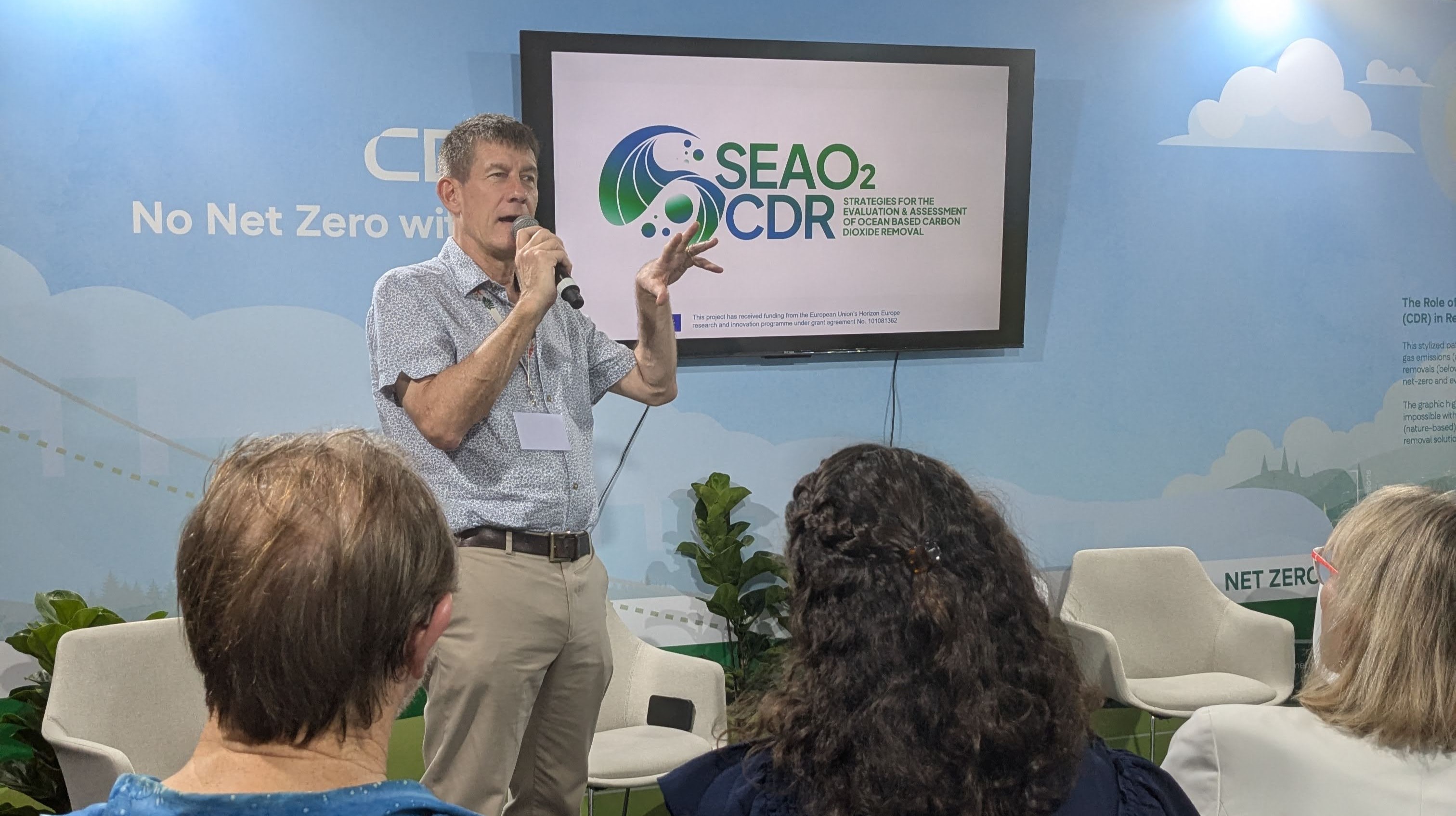
Shaun also took part in a panel discussion in CDR30, the first pavilion focused entirely on carbon dioxide removal, where marine approaches were discussed alongside terrestrial solutions - highlighting the enormous potential of the ocean for mCDR.
The panel was moderated by Diane Hoskins (Carbon to Sea Initiative), and also featured Sue Biniaz (former US lead negotiator), Anna-Maria Laura (Ocean Conservancy), and María José Urrutia Rivas (Katrawa).
Shaun highlighted the following takeaways:
- Breaking silos: Scientific communities must collaborate across disciplines and beyond the climate space.
- Field research: Essential for testing models objectively, not just validating them.
- Policy readiness: While CDR is gaining traction, mCDR should not yet be in NDCs until science is stronger.
- Framing matters: Benefits beyond climate vary globally and must be understood.
- Inclusive learning: As María José noted, we have much to learn from often-excluded voices and regions.
- Log in to post comments